
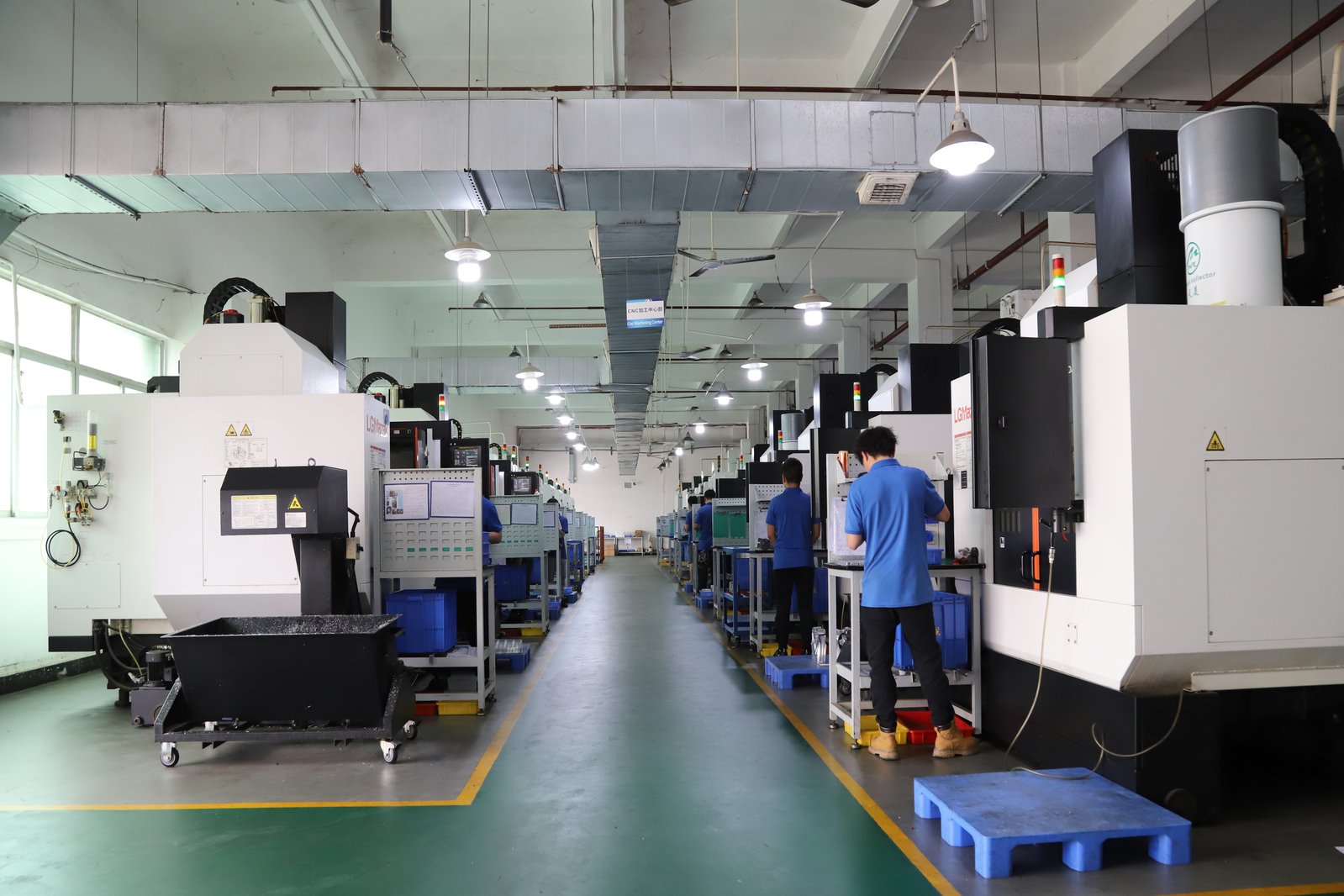
- Dongguan Zhuohang Ltd (Registration No. 91441900MA4UWT6X39), operating as Zhuohang Precision Machining Factory, established 2005; 100+ CNC machines; certified to ISO 9001:2015, IATF 16949:2016 (excluding clause 8.3 product design) and ISO 14001:2015; holding ±0.003 mm CNC milling / ±0.002 mm CNC turning tolerance.
- CNC Machining cuts from a solid blank; injection moulding injects molten plastic into a steel mould.
- CNC Machining is the default for metal, for precision, and for any quantity below the mould break-even.
- Injection moulding wins only at high plastic-part volume where the mould cost is spread across the run.
How the two processes make the part
CNC Machining is subtractive: a metal or plastic blank is cut to the CAD model, so the first article is available in days with no part-specific tooling and design changes are cheap. Injection moulding is formative in plastic: a steel mould is filled with molten thermoplastic under pressure. The mould is the entire economic equation — expensive to make, but negligible marginal cost once paid for — and it only applies to plastics, never to metal.
Side-by-side comparison
| Factor | CNC machining | Injection moulding |
|---|---|---|
| Tooling | CAD/CAM + cutters; first article in days, no part-specific tool | Steel mould $5k–$100k+; design, machining and sampling take weeks |
| Lead time (first article) | 1–3 days from CAD | 4–10 weeks including mould |
| Economic batch | 1-off to hundreds | 1,000–100,000+ to amortise the mould |
| Materials | Metals and plastics cut from solid stock | Thermoplastics (ABS, PC, PA, PEEK, POM) and some thermosets |
| Tolerance | ±0.003–0.05 mm | ±0.1–0.3 mm (mould shrinkage varies) |
| Wall thickness | No absolute minimum | Min ~0.5–1 mm to fill the cavity |
| Geometry | Solid 3D within cutter access | Hollow, ribbed, snap-fit shells come naturally |
| Material structure | From solid stock — isotropic | Flow lines, weld lines, sink marks possible |
| Design change cost | CAD edit, near zero | New or modified mould — expensive |
| Post-processing | Deburr, anodise, plate | Gate removal, deflash, sometimes vapour smooth |
| Typical applications | Metal parts, precision, prototypes | High-volume plastic enclosures, housings |
Where CNC Machining wins, where injection moulding wins
CNC Machining wins whenever the part is metal, must hold ±0.003–0.05 mm, needs internal or asymmetric 3D detail, or is needed in any quantity below the mould amortisation point (often 1,000–10,000 parts). Injection moulding wins for very high volumes of a plastic component where wall thickness, ribs and snap-fits are wanted and the tooling can be absorbed by the run. For metal requirements the comparison ends immediately — moulding simply does not apply.
Material structure and properties
CNC Machining from solid stock yields isotropic properties and predictable performance traceable to the mill certificate. Moulded plastic parts show flow lines, potential weld lines at merge points and sink marks on thick sections; these are managed by gate placement and wall-thickness control rather than eliminated. For a metal requirement, CNC Machining is the only of the two that can deliver it.
Process-selection checklist
- Part must be metal? → CNC Machining (injection moulding is plastic only).
- Need <1,000 parts or a quick prototype? → CNC Machining.
- Plastic part, >10,000 off, with thin walls/ribs? → injection moulding.
- Need ±0.01 mm or better? → CNC Machining.
- Moulded part must locate precisely? → machine critical faces by CNC Machining.
Post-processing
CNC Machining parts are deburred and finished (anodise, plate, paint, passivate). Moulded parts need gate and flash removal, may be vapour-smoothed, and often have the precision datums machined if the application demands it; cosmetic moulded surfaces still depend on mould polish rather than a separate finish.
Frequently Asked Questions
When should I choose CNC Machining instead of injection moulding?
Choose CNC Machining for metal parts, for tight tolerance, and for any volume below the mould break-even. Choose injection moulding only for high-volume plastic parts with thin walls and integrated features.
What tolerance can CNC Machining hold versus injection moulding?
CNC Machining holds ±0.003–0.05 mm. Moulded plastic is around ±0.1–0.3 mm because of shrinkage variation between cavities and runs.
Is injection moulding cheaper?
Per part at volume, yes — but only after the $5k–$100k+ mould is paid off. Below that, CNC Machining is far cheaper because there is no tooling.
Can plastic parts be CNC machined?
Yes. Plastic prototypes and low-volume parts are often machined from solid stock by CNC Machining to avoid mould cost entirely.
Cost crossover in practice
When you are choosing, the question is rarely which process is "better" and almost always about batch size. As a working rule for a part of moderate complexity: CNC Machining costs a few tens of dollars in machine time per piece with no upfront tooling, so 100 parts might total a few thousand dollars. Injection moulding needs tooling in the low five figures, so the same 100 parts would be far more expensive once the tool is paid for — but at 10,000 parts the per-piece tooling share falls to cents and the formative process wins decisively. The practical crossover for most components lands between 1,000 and 5,000 pieces; above it, amortised tooling dominates, below it, CNC Machining is cheaper and far more flexible. Always quote both before you commit, because material yield, secondary operations and scrap rate shift the exact break-even for your part.
Design-for-manufacturing tips
- Keep functional tolerances at ±0.02–0.05 mm where cnc precision machining is used; reserve ±0.003 mm (milling) / ±0.002 mm (turning) for critical datums only — every tighter band adds cost.
- Design for standard stock sizes and minimise deep, narrow cavities that need long-reach or 5-axis tooling.
- If volume will rise, design the part so it can later move to injection molding without changing the interface — locate on the same datums.
- Specify surface finish only where it matters; machined finish is cheap, plating and anodising are the cost drivers.
Break-even analysis and the design levers that move it
The break-even between CNC milling and injection molding is not a fixed quantity; it moves with part geometry, material, tolerance, and the molding tool's amortisation schedule. The rule of thumb — injection molding wins above 1,000 pieces, CNC milling wins below — is true for a simple prismatic part in aluminum and wrong for everything else. If you run the break-even on each part, you pick the right process; if you apply the rule of thumb to every part, you pick the wrong process for half of them.
The molding tool is the dominant fixed cost. A single-cavity aluminum prototype mold for a 200 × 150 mm part runs $3,000-8,000; a single-cavity steel production mold for the same part runs $12,000-30,000; a multi-cavity steel mold runs $30,000-150,000 depending on cavity count and complexity. The tool amortises across the parts run through it: at $15,000 tool cost and $5 per part unit, the break-even against a $25 CNC-milled part is at 750 pieces ($15,000 / ($25 - $5) = 750). Below 750 pieces CNC milling wins; above 750 injection molding wins — for that specific geometry, material, and tolerance. Change any of those and the break-even moves by hundreds of pieces.
Three design levers move the break-even. Part size scales mold cost faster than CNC cost: a 50 mm part's mold is $5,000 and a 500 mm part's mold is $80,000, but the CNC cost of the 50 mm part is $8 and the 500 mm part is $40 — the ratio shifts the break-even from 250 pieces (small part) to 2,000 pieces (large part). Material shifts the break-even through cycle time: aluminum CNC parts run 2-4 minutes each; steel CNC parts run 8-15 minutes each; molded parts in any material run 15-60 seconds each. The cycle time gap means injection molding's advantage scales with material hardness — on titanium, the break-even is at 200 pieces; on aluminum, at 1,000 pieces. Tolerance shifts it through scrap rate: a part at ±0.05 mm is moldable; the same part at ±0.003 mm needs post-machining after molding, which adds $3-8 per part and pushes the break-even to 1,500-2,000 pieces.
The hybrid strategy is the one most buyers like you miss: mold the rough geometry, machine the precision features. A housing at 1,000 pieces with two ±0.003 mm bores and ±0.1 mm walls is moldable for the walls and post-machinable for the bores — the molding tool is $8,000, the post-machining is $4 per part, the unit is $9 against $25 for full CNC. The hybrid wins at 400 pieces, not 1,000. A shop that runs both processes under one roof (or that subcontracts molding with in-house post-machining) is the one that can quote the hybrid path; one that runs only one process is the one that pushes the wrong process.
The honest answer for you choosing "CNC milling vs injection molding" is: run the break-even on the specific part, not the rule of thumb. State the part size, material, tolerance, and annual volume, and the break-even computes itself. A shop that returns a number is one whose quote holds; one that returns a slogan is one whose quote moves.
Material selection and what it costs the molding tool
Material choice drives both the molding tool cost and the post-molding shrinkage the part will see. The same geometry in different plastics calls for different mold steel, different cooling regimes, and different shrink compensation, and each of those changes the tool cost by 20-50 percent. ABS shrinks 0.5-0.7 percent and runs in P20 mold steel at $8,000-15,000 for a single-cavity tool; glass-filled nylon shrinks 0.2-0.5 percent but abrades the mold, requiring H13 hardened steel at $12,000-25,000; polycarbonate shrinks 0.5-0.7 percent but runs hot, requiring conformal cooling channels that add $2,000-5,000 to the tool; PEEK shrinks 1.0-1.5 percent and runs in H13 at high temperature, requiring $20,000-40,000 tools with extended cycle times. If you specify only "plastic" on the RFQ, you force the molder to assume, and the assumption costs you in tool over-engineering or in parts that miss the tolerance.
The shrink compensation is the number most buyers miss. Every plastic shrinks as it cools from melt to solid; the mold is cut larger than the finished part by the shrink percentage. A part at 100 mm in ABS (shrink 0.6 percent) requires a mold at 100.6 mm; the same part in glass-filled nylon (shrink 0.3 percent) requires a mold at 100.3 mm. If the material is changed after the tool is cut, the part arrives at the wrong size and the tool is scrap. A shop that asks the material before cutting the tool is one whose parts arrive at the drawing size; one that cuts the tool without confirming the material is one whose parts miss by the shrink percentage, and the shrink percentage is not a rounding error.
The cooling regime is the third cost lever and the one the buyer cannot see. A mold without conformal cooling runs a 30-60 second cycle; with conformal cooling channels cut into the steel near the part, the cycle drops to 15-30 seconds. At 10,000 pieces the cycle time difference is 80-280 machine-hours, which is the difference between a profitable and an unprofitable molding run. Conformal cooling adds $3,000-8,000 to the tool but pays back on any run above 5,000 pieces; below that volume the standard cooling is cheaper. A molder that quotes the cooling regime is one whose lead-time holds; one that quotes only the tool cost is one whose cycle time is whatever it is.
What this shop actually runs
If you ask for capability evidence, you deserve a specific answer. This facility operates 100+ CNC machines across 6,800 m2 in Dongguan, China, staffed by 100+ people. The machines, listed by category:
- 5-axis machining centres (10+) - Mazak VARIAXIS I-600 (510/910/510 mm travel, 12,000 rpm, 22 kW, 71.6 N·m, 30-tool BT40) and Mazak INTEGREX I-250H S (B-axis 0.0001°, 24 kW, 124 N·m, 38-tool HSK-A63). Intended for compound-angle parts, single-setup multi-face prismatic work, and aerospace fittings where datum transfer loss is unacceptable.
- 3-axis / 4-axis machining centres (50+) - Brother SPEEDIO S500Z2N / S700Z2N (10,000 rpm, 14/21-tool ATC, 0.7 s tool-to-tool, Z-axis 2.2 G) and Mazak VCE-430A L / VCE-570C L (10,000 rpm, 118 N·m, 24-tool ATC). Intended for prismatic parts, plates, brackets, housings.
- Swiss-type turning centres (10+) - Citizen Cincom A20-3F7 (Φ20 mm, 10,000 rpm), TSUGAMI B0206-III / B0205-III (Φ20 mm, 0.1 µm), STAR SR-32JII / SR-32J Type N (Φ32 mm, 8,000 rpm). Intended for long, slender rotational parts at ±0.002 mm.
- CNC turning centres (20+) - HEADMAN T70M/1250 (720 mm swing, 117 mm bore, 3,000 rpm, BMT75 12-station turret). Intended for shafts, bushings, flanges up to ±0.002 mm.
- Wire EDM (5+) - Sodick AQ535L (550/350/300 mm travel, ±20° taper, 800 kg workpiece). Intended for hardened tool steel, internal splines, sharp internal corners that milling cannot reach.
- Inspection: Hexagon CMM + 20+ gauges - Hexagon CMM for coordinate measurement, plus vision system, profilometer, hardness tester, coating thickness gauge, XRF for material verification. The 10:1 rule (gauge 10x more accurate than the band) is applied to every feature.
- Machine highlights - VARIAXIS I-600: one-setup multi-face 5-axis + MAZA-CHECK auto-calibration; INTEGREX I-250H S: DONE-IN-ONE mill-turn, B-axis 0.0001° + Ai thermal shield; SPEEDIO S500Z2N / S700Z2N: Z-axis 2.2 G + 0.7 s ATC; Swiss-type: guide-bush switchable + 0.1 µm resolution.
Tolerance bands: ±0.003 mm milled, ±0.002 mm turned, ±0.002 mm ground or wire-cut. Capability indices: Ppk >= 1.67 at the initial study; Cpk >= 1.33 ongoing in production.
Certifications: ISO 9001:2015 (116024/A/0001/UK/En) · IATF 16949:2016 (131941/A/0001/SM/En, design clause 8.3 excluded) · ISO 14001:2015 (116024/B/0001/UK/En), held by Dongguan Zhuohang Ltd (USCC 91441900MA4UWT6X39, since 2005).
Service area: we supply Austria, Belgium, the Czech Republic, Denmark, France, Germany, Greece, Hungary, Ireland, Italy, the Netherlands, Spain, Sweden and the United Kingdom in Europe; Brazil, Canada, Mexico and the United States in the Americas; China, Israel, Japan, Singapore and Sri Lanka in Asia; Australia and New Zealand in Oceania; and South Africa in Africa, with worldwide delivery from China.
Contact: Felipe Iglesias, [email protected], +86 13126536955.
Continue reading: 3 Axis CNC Precision Machining · 4 Axis CNC Precision Machining · 5 Axis CNC Precision Machining
Standards referenced on this page
- ASTM B211/B211M-19 — Standard Specification for Aluminum-Alloy Rolled or Cold Finished Bar, Rod, and Wire
- ASTM B209/B209M-21 — Standard Specification for Aluminum-Alloy Sheet and Plate
- ISO 9001 — Quality management systems — Requirements