
CNC Precision Machining Factory
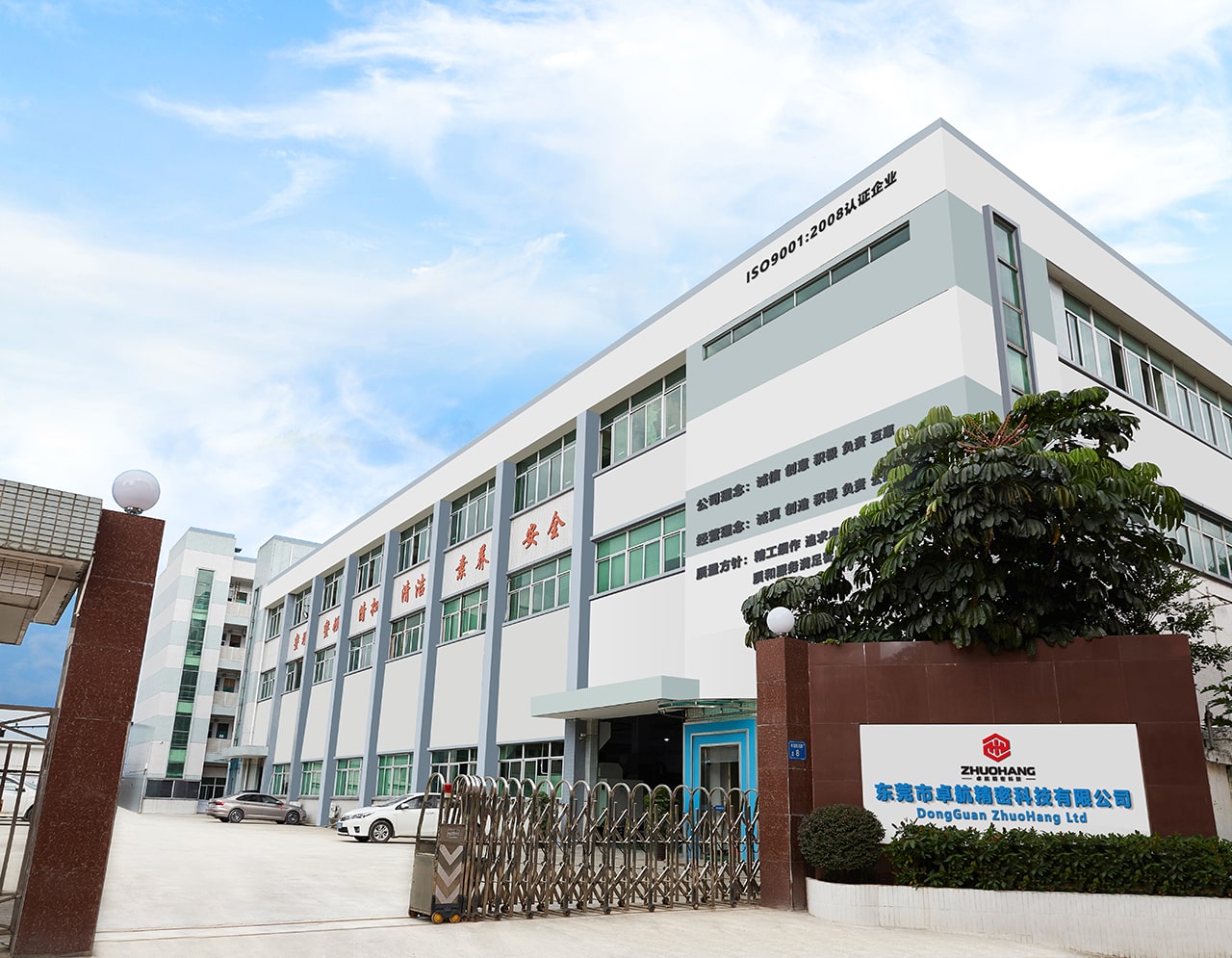
The factory machines the materials engineers specify on drawings, not a narrow comfort zone. Aluminum, stainless steel, carbon and alloy steel, brass, copper, titanium, and magnesium, plus engineering plastics such as ABS, POM, nylon, PTFE, and PEEK. Every incoming lot is XRF-checked against its mill certificate, so the alloy you ordered is the alloy on the part.
The parts ship into automotive, robotics, electronics, medical, and automation machinery and equipment — the industries where a fit has to be right the first time. That breadth means the process discipline developed for automotive-grade programs is applied to every job, not just the regulated ones.
Which certifications does the factory hold?
Three certificates, all third-party-surveyed, with the scope stated honestly.
| Standard | Certificate number | Scope |
|---|---|---|
| ISO 9001:2015 | 116024/A/0001/UK/En | Machining of metal parts |
| IATF 16949:2016 | 131941/A/0001/SM/En | Manufacture of CNC metal machining parts (excludes product design, Clause 8.3) |
| ISO 14001:2015 | 116024/B/0001/UK/En | Environmental management related to machining of metal parts |
Honest scope note: IATF 16949 excludes product design under Clause 8.3. We are a build-to-print manufacturer — if your program needs design ownership, say so up front and we will scope it correctly rather than over-promise.
How does the factory handle surface finishing and heat treatment?
Most parts need more than machining. Surface finishing and heat treatment complete the fit — an anodized bore and a machined bore are different final sizes — and both are managed in the same workflow.
- Surface finishing: standard and hard anodizing, zinc / nickel / silver / gold / chrome plating, powder coating, painting, brushing, and mirror polishing.
- Heat treatment: vacuum, bright, carburizing, nitriding, and stress-relief aging. In-house ovens reach 500 °C; titanium stress relief above that goes to a qualified partner, because the requirement is ~788 °C and we do not pretend our ovens reach it.
That last sentence is the honesty you should look for: a shop that states where its capability ends is a shop you can trust on where it begins.
How does the factory protect your drawings and data?
Precision machining is built on drawings that carry real value, and you should know how a shop treats them before sending proprietary geometry. Sensitive paper documents are stored in a restricted, locked space; electronic files sit on encrypted drives; and access is limited to the engineers working the program. Data is used, stored, and disposed of on a need-to-know basis rather than left on a shared drive.
The same discipline extends to the code of conduct the factory runs under: compliance with law, no forced or child labor, environmental responsibility under ISO 14001, anti-bribery, and confidentiality. Solar panels on the roof generate about 20,000 kWh of power a month, and every employee is on a formal labor contract with social insurance. These are the things you should be able to confirm on a visit, and can.
Why Dongguan for precision machining?
Dongguan sits at the center of the Pearl River Delta's machining supply chain, which matters for two practical reasons. First, raw material — certified bar stock and plate in the alloys buyers specify — is available locally and verifiably. Second, the supporting ecosystem of heat treatment, anodizing, and plating partners is mature enough to run to a documented quality standard, not to a handshake.
For you, the location is not about the lowest labor cost; it is about supply-chain reliability and metrology. A shop that can source verified material next door and measure it on a Hexagon CMM in the same building is a shop that can hold a tolerance, and prove it, with a report, on schedule.
Can a buyer visit or audit the factory?
Yes, and you should. A factory visit settles in an hour what a hundred emails cannot: whether the machines are real, whether the metrology bench is staffed, and whether the place runs to the certificates on the wall. We welcome visits and third-party audits at:
No. 8, Shuibian Songyuan Road, Hengli Town, Dongguan, Guangdong, China 523470.
Contact [email protected] to schedule, and bring a drawing — an on-the-spot design-for-manufacturing review is the fastest way to find out whether we can hold your tolerances.
How does a job run from quote to shipment?
A job moves through a defined path, and the path is why lead time stays predictable. It starts with the drawing: a DFM and quality review maps each callout to a process and a verification method, and flags anything the process cannot hold before metal is cut. Then programming — the toolpaths and the CMM inspection program are written from the same CAD model, so the part is checked the way it was machined. Then setup and first article: the first part is measured fully, and only when it passes does the run start.
Machining, then inspection at the machine and on the CMM, then finishing and heat treatment where the print calls for them, then final inspection, packing, and shipment with the reports. Every step has an owner and a record, which is what lets the shop tell you — honestly — where your order sits.
How does the factory keep the machines and instruments accurate?
Machines hold tolerances; maintenance keeps them honest. Production equipment runs on a preventive maintenance schedule, and the CMMs and instruments are calibrated against traceable standards on a fixed cycle, held to the ISO 1 reference temperature of 20 °C. Tool management matters equally: cutting tools are tracked by usage, because a worn tool is the most common silent drift in a dimension. When a machine shows drift in its SPC data, it is corrected before it produces scrap, not after.
For you, the question to ask is not "how many machines do you have" but "what happens when one of them drifts." A shop with a maintenance and calibration program can answer that with a procedure; a shop without one answers with a shrug.
How is capacity planned and lead time kept honest?
Capacity is not a marketing number; it is a scheduling discipline. The floor's a hundred-odd machines and 100+ people are scheduled against real jobs, with the envelope — milling to 1300 × 700 × 600 mm, turning to Ø720 × 1280 mm — stated up front so a part that does not fit is flagged before quoting. Lead time is set by the number of process steps, not by a blanket promise, and the 3 / 7 / 30-day tiers reflect how many operations and how much finishing a part carries.
A shop that quotes the same lead time for a one-operation shaft and a twenty-step housing is not planning; it is guessing. Ask how a job is loaded onto the schedule and how a delay is handled — the answer tells you whether the date you are given is a plan or a hope.
How does the factory manage a program over time?
For you who repeats an order, the value is in the history. Repeat jobs inherit the proven setup, tooling, and inspection program, so the second run is faster and more stable than the first. The SPC record from the first run sets the baseline the next run is measured against, and any drift is caught early because there is a history to compare. Engineering changes flow through the same DFM review as a new part, so a revised drawing is re-verified rather than assumed.
This is what turns a supplier into a source: the tenth batch is not a new gamble, it is a known process with a chart behind it. Ask how a shop handles repeat orders and revisions; a shop with real process control will point to the record, not to a new quote.
What should a buyer look for on a factory visit?
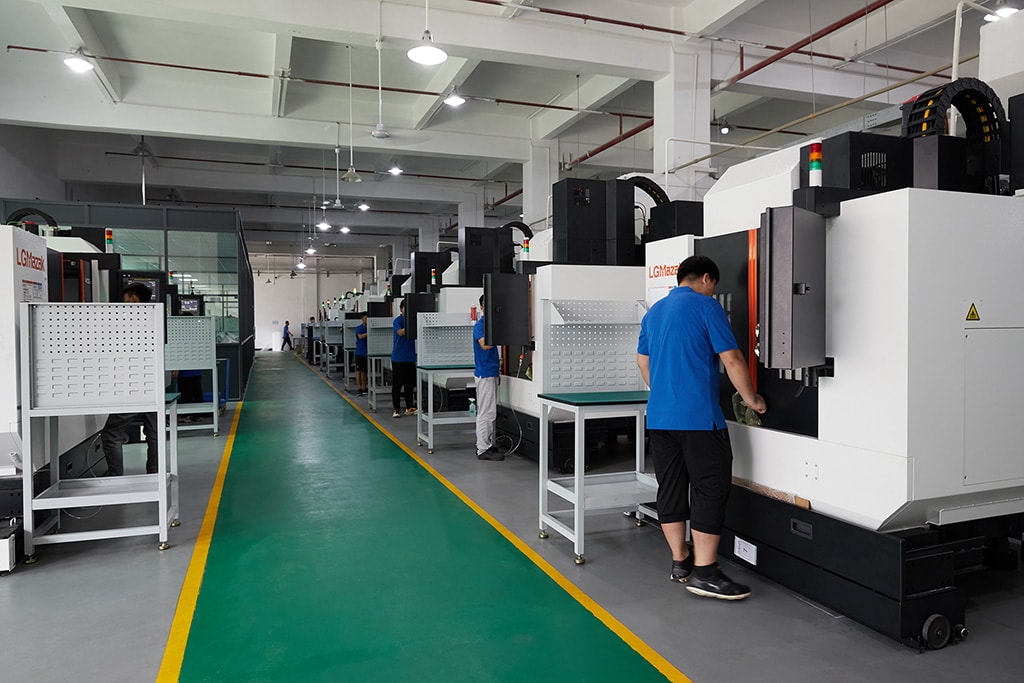
A visit settles in an hour what email cannot. Walk the floor and look for three things. First, is the metrology bench staffed and busy, or is it a corner display? A shop that measures every job has CMMs and vision machines running, not gathering dust. Second, are the machines the same ones the shop named, and are they production class — Mazak, Brother, Citizen, Star, Tsugami — or a mix of hobby machines? Third, does the material coming in match the certificates on the wall — is there an XRF check at receiving, and does the stock rack show controlled, labeled lots?
If you walk the floor and ask these three questions, you will know more about a shop's real capability in one hour than a hundred brochure claims would ever reveal.
What this shop actually runs
If you ask for capability evidence, you deserve a specific answer. This facility operates 100+ CNC machines across 6,800 m2 in Dongguan, China, staffed by 100+ people. The machines, listed by category:
- 5-axis machining centres (10+) - Mazak VARIAXIS I-600 (510/910/510 mm travel, 12,000 rpm, 22 kW, 71.6 N·m, 30-tool BT40) and Mazak INTEGREX I-250H S (B-axis 0.0001°, 24 kW, 124 N·m, 38-tool HSK-A63). Intended for compound-angle parts, single-setup multi-face prismatic work, and aerospace fittings where datum transfer loss is unacceptable.
- 3-axis / 4-axis machining centres (50+) - Brother SPEEDIO S500Z2N / S700Z2N (10,000 rpm, 14/21-tool ATC, 0.7 s tool-to-tool, Z-axis 2.2 G) and Mazak VCE-430A L / VCE-570C L (10,000 rpm, 118 N·m, 24-tool ATC). Intended for prismatic parts, plates, brackets, housings.
- Swiss-type turning centres (10+) - Citizen Cincom A20-3F7 (Φ20 mm, 10,000 rpm), TSUGAMI B0206-III / B0205-III (Φ20 mm, 0.1 µm), STAR SR-32JII / SR-32J Type N (Φ32 mm, 8,000 rpm). Intended for long, slender rotational parts at ±0.002 mm.
- CNC turning centres (20+) - HEADMAN T70M/1250 (720 mm swing, 117 mm bore, 3,000 rpm, BMT75 12-station turret). Intended for shafts, bushings, flanges up to ±0.002 mm.
- Wire EDM (5+) - Sodick AQ535L (550/350/300 mm travel, ±20° taper, 800 kg workpiece). Intended for hardened tool steel, internal splines, sharp internal corners that milling cannot reach.
- Inspection: Hexagon CMM + 20+ gauges - Hexagon CMM for coordinate measurement, plus vision system, profilometer, hardness tester, coating thickness gauge, XRF for material verification. The 10:1 rule (gauge 10x more accurate than the band) is applied to every feature.
- Machine highlights - VARIAXIS I-600: one-setup multi-face 5-axis + MAZA-CHECK auto-calibration; INTEGREX I-250H S: DONE-IN-ONE mill-turn, B-axis 0.0001° + Ai thermal shield; SPEEDIO S500Z2N / S700Z2N: Z-axis 2.2 G + 0.7 s ATC; Swiss-type: guide-bush switchable + 0.1 µm resolution.
Tolerance bands: ±0.003 mm milled, ±0.002 mm turned, ±0.002 mm ground or wire-cut. Capability indices: Ppk >= 1.67 at the initial study; Cpk >= 1.33 ongoing in production.
Certifications: ISO 9001:2015 (116024/A/0001/UK/En) · IATF 16949:2016 (131941/A/0001/SM/En, design clause 8.3 excluded) · ISO 14001:2015 (116024/B/0001/UK/En), held by Dongguan Zhuohang Ltd (USCC 91441900MA4UWT6X39, since 2005).
Service area: we supply Austria, Belgium, the Czech Republic, Denmark, France, Germany, Greece, Hungary, Ireland, Italy, the Netherlands, Spain, Sweden and the United Kingdom in Europe; Brazil, Canada, Mexico and the United States in the Americas; China, Israel, Japan, Singapore and Sri Lanka in Asia; Australia and New Zealand in Oceania; and South Africa in Africa, with worldwide delivery from China.
Contact: Felipe Iglesias, [email protected], +86 13126536955.
Visit, audit, or send a drawing — the door is open.
Email [email protected] or call +86 13126536955 to schedule a visit or request a quote.
Frequently Asked Questions
Are you a manufacturer or a trading company?
In short, We are a manufacturer. Dongguan Zhuohang Ltd
How long has the factory been machining precision parts?
The company was founded in 2005, and its founder has 28 years of industry experience. We have served more than 100 domestic and overseas customers across automotive, robotics, electronics, medical, and automation equipment.
Which machines hold the tolerances?
The floor runs 50+ 3-axis, 20+ 4-axis, and 20+ 5-axis milling centers, 25+ CNC lathes, and 7+ grinders, from Mazak, Brother, Citizen, Star, and Tsugami. Tolerances are verified on Hexagon CMMs rather than trusted to the machine alone.
Which industries do you serve?
Automotive, robotics, electronics, medical, and automation machinery and equipment. The parts cover aluminum, stainless steel, brass, copper, titanium, magnesium, and engineering plastics.
Can I visit or audit the factory?
Yes. We welcome factory visits and audits at No. 8, Shuibian Songyuan Road, Hengli Town, Dongguan, Guangdong, China 523470. Contact Felipe at [email protected] to schedule.
Are you certified?
Yes. We hold ISO 9001:2015, IATF 16949:2016, and ISO 14001:2015. The IATF 16949 scope excludes product design under Clause 8.3, so we are a build-to-print manufacturer.
Continue reading: 3 Axis CNC Precision Machining · 4 Axis CNC Precision Machining · 5 Axis CNC Precision Machining
Standards referenced on this page
- IATF 16949:2016 — Automotive quality management system standard
- ASTM B348/B348M-21 — Standard Specification for Titanium and Titanium Alloy Bars and Billets
- ASTM B211/B211M-19 — Standard Specification for Aluminum-Alloy Rolled or Cold Finished Bar, Rod, and Wire